



Defensible whistleblowing and case management platform
Why a simple whistleblowing channel is not enough for regulatory compliance
A reporting channel is only the beginning. What defines your risk exposure is what happens after a report is submitted – and whether your systems can withstand the scrutiny that follows.
Trusted by 14,000+ organizations globally










The reality compliance leaders live with
Most organisations have reporting channels. Few can say with confidence that they have full, auditable oversight of what happens after a report is submitted – or that their investigation process would hold up under regulatory scrutiny on a Friday night.
A scenario: Friday night, 22:47
A sensitive report lands. It’s incomplete. It may be material — or it may not. You can’t yet tell. In the next 96 hours, four pressures converge simultaneously:
- Protect the whistleblower’s anonymity — technically, not just in policy.
- Triage correctly, with no single reliable view of related prior cases
- Coordinate Legal, HR, and Compliance — without a structured handoff mechanism
- Prove — on demand — that you acted appropriately and within regulatory timelines
Now the Board requests a status update. The information exists — across email threads, shared drives, and task trackers — but it isn’t consolidated. The picture you present is fragmented. And fragmented reporting erodes credibility at exactly the moment credibility is most needed.
The risk isn’t the report. The risk is the system underneath it — and every step that occurs outside of it.
The two silent failures of
most whistleblowing programs
01 Silence
If employees suspect that anonymity isn’t technically real — not just promised — they won’t report early. If the process feels burdensome, uncertain, or intimidating, they won’t report at all.
A speak-up channel must be credibly anonymous and effortless: clear, accessible, and frictionless in moments of genuine uncertainty — when the personal stakes for the reporter feel highest.
Underreporting is the most dangerous — and least visible — failure of any compliance program.
02 Investigation Breakdown
Most tools are built for linear investigations. Real investigations are not linear. They loop, branch, escalate, and involve multiple stakeholders across functions and jurisdictions — sometimes simultaneously.
When software cannot adapt to this reality, teams create workarounds. Workarounds introduce inconsistency. Inconsistency undermines defensibility. And a program that cannot demonstrate consistent, structured handling is one that does not survive regulatory scrutiny.
Whistleblowing rarely fails at intake. It fails in handling.
What modern whistleblower platform actually requires
Defining modern whistleblowing platform
Modern whistleblowing platform is not a reporting hotline with a case log attached. It is a connected governance system in which intake, investigation workflow, regulatory deadline management, and executive-level insight operate as a single, auditable operating environment – designed to meet the requirements of the EU Whistleblower Directive, HinSchG, and Sapin II, and to withstand ad hoc regulatory scrutiny at any point in the case lifecycle.
To meet HinSchG, Sapin II, and EU Whistleblower Directive expectations, and withstand regulatory scrutiny, four conditions must hold:
Anonymity must be technically defensible.
Where anonymity is offered, it must be upheld at the structural level — not just a policy commitment. Confidentiality must be rigorously protected through the case lifecycle.

Case handling must be structured yet flexible.
Investigations must be documented, independent, and consistent — while remaining adaptable to changes in scope, conflicts of interest, new evidence, and evolving severity assessments.
Deadlines and documentation must be systematically controlled.
Acknowledgement timelines and case records cannot rely on manual tracking. Automation is the most reliable mechanism for ensuring regulatory compliance and audit readiness.

Leadership must have continuous visibility into risk signals.
Aggregated risk insights — not isolated case summaries — must be continuously accessible to leadership to enable risk mitigation, decisions and program improvement.
Gaps in any of these four areas are where regulatory criticism most often begins.
From reactive case handling to connected compliance governance
Leading organisations are redesigning whistleblowing and case management as a unified governance system — integrating intake, investigation, regulatory workflow, and board-level insight into a single operating environment.
The shift is from analogue to digital. It is from isolated, reactive tools to a connected system capable of supporting defensible outcomes across every stage of the case lifecycle.
Fragmented programs
Risks and limitations
- Anonymous inboxes without technically credible protection
- Linear tools that break under investigation complexity
- Reactive, last-minute board reporting assembled manually
- Deadline tracking dependent on individual diligence
- Documentation reconstructed under scrutiny, not preserved throughout
Integrated platform
Key capabilities
- Zero-tracking anonymity architecture — technically verifiable, not promised
- Non-linear investigation workflows that adapt without breaking the audit record
- Executive-level compliance analytics available continuously, not compiled on request
- Regulatory-aware workflows with automated deadline management
- Audit-ready documentation, systematically preserved from intake to closure
Secure whistleblowing channels: the foundation of employee trust
The whistleblowing channel is the foundation of program credibility. If employees question whether their anonymity is real, or find the process opaque and difficult to navigate, they will not use it. The result is systematic underreporting: the organization sees only the cases it was willing to make easy to report.
EQS Integrity Line is designed to eliminate this failure mode. Two-way communication with whistleblowers is preserved without exposing identity. And the reporting experience is calibrated to be frictionless in the moments that matter most: when a reporter is uncertain, cautious, and evaluating personal risk.
Zero-tracking anonymity architecture
Technically enforced, not policy-dependent. No IP logging, no metadata exposure. Anonymity that survives legal challenge.
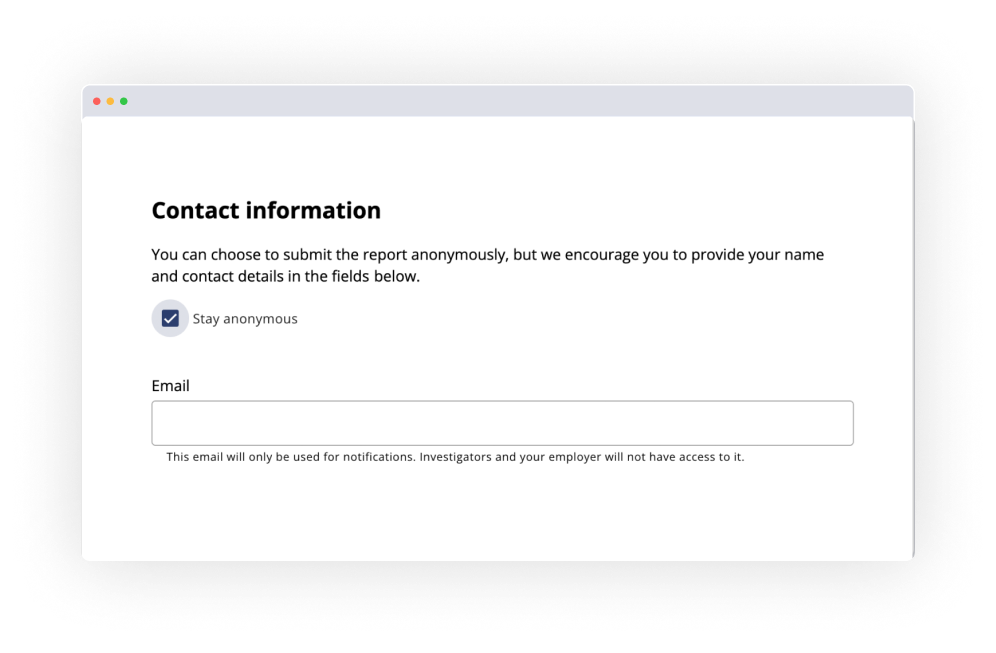
Secure two-way communication
Dialogue with the reporter — to clarify, follow up, and close feedback loops — without any risk of identity disclosure.
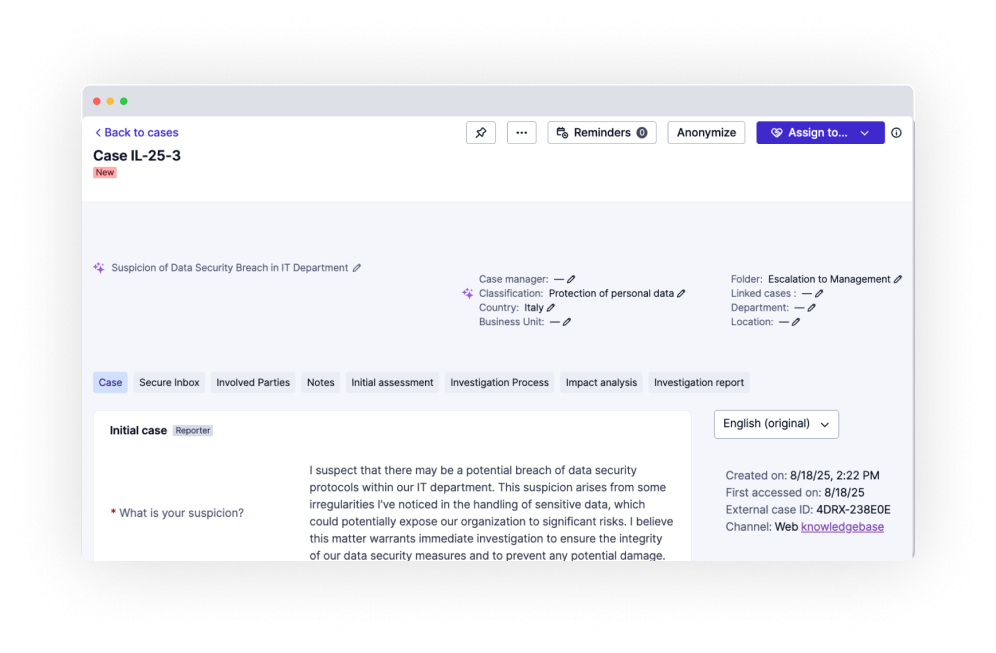
Regulatory-aware design
Aligned to the EU Whistleblower Directive, HinSchG, and Sapin II. Built to meet what regulators actually examine — not just what checklists ask for.
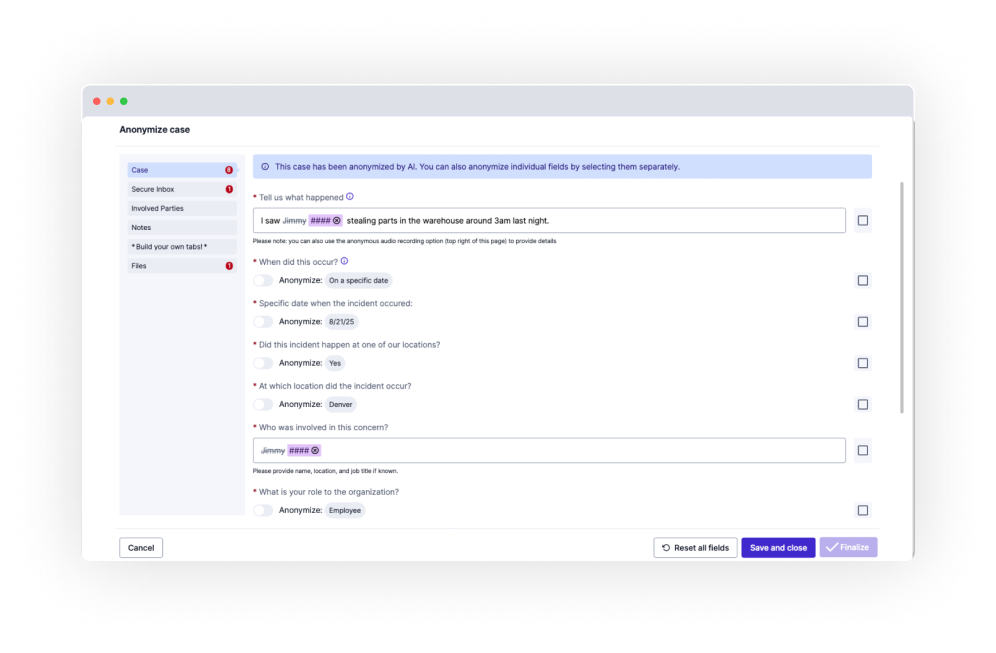
Audit-ready documentation from intake
Case records are systematically preserved from the moment a report is received — not reconstructed when scrutiny arrives.
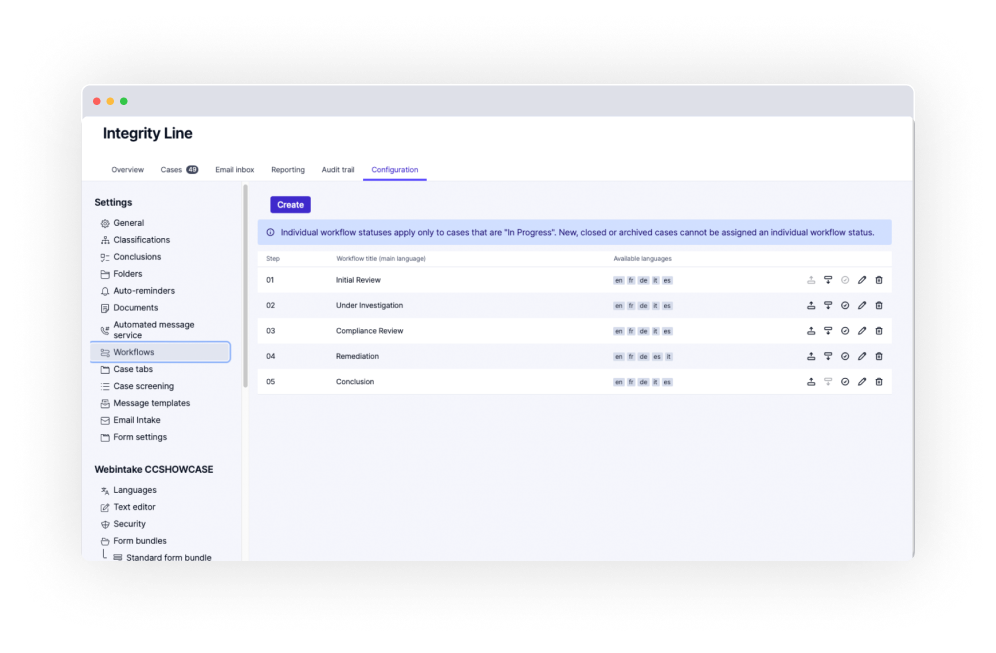
Integrating whistleblowing intake with EU Directive, HinSchG, and Sapin II requirements is not a configuration exercise. It requires a system designed around those obligations from the ground up.
EQS advanced case management:
Built for investigations that don’t follow a script.
Most case management tools are designed for a world where investigations move in one direction: intake, assessment, investigation, close. In practice, an investigation into potential misconduct rarely works this way. Scope expands. New witnesses are identified. Jurisdictional complexity surfaces. A conflict of interest requires a stakeholder to be recused mid-process.
When the system cannot accommodate this reality, the team accommodates it instead – through workarounds that exist outside the platform, outside the audit record, and outside the governance framework. That gap is where regulatory exposure lives.
Controlled flexibility
Move between investigation stages and reassign ownership across stakeholders — without losing data integrity or breaking the chain of custody.
Workflow mirroring
Whether your process runs a simple intake-to-close flow or a complex, multi-function investigation, the system adapts to your program’s reality.
Defensible outcomes
Every action, escalation, scope change, and stakeholder involvement is systematically preserved — even when investigations loop back or evolve mid-stream.
Program maturity by design
Begin with the configuration your program needs today. Activate advanced investigation logic as your governance environment evolves. You will not outgrow the system.
The Board doesn’t need more data. It needs to see risk.
Most compliance teams don’t lack data. They lack a reliable, consolidated view of what it means – and the ability to present that view to the Board in a form that demonstrates program value rather than simply program activity.
EQS Insights – Connected analytics, native to the Compliance Cockpit
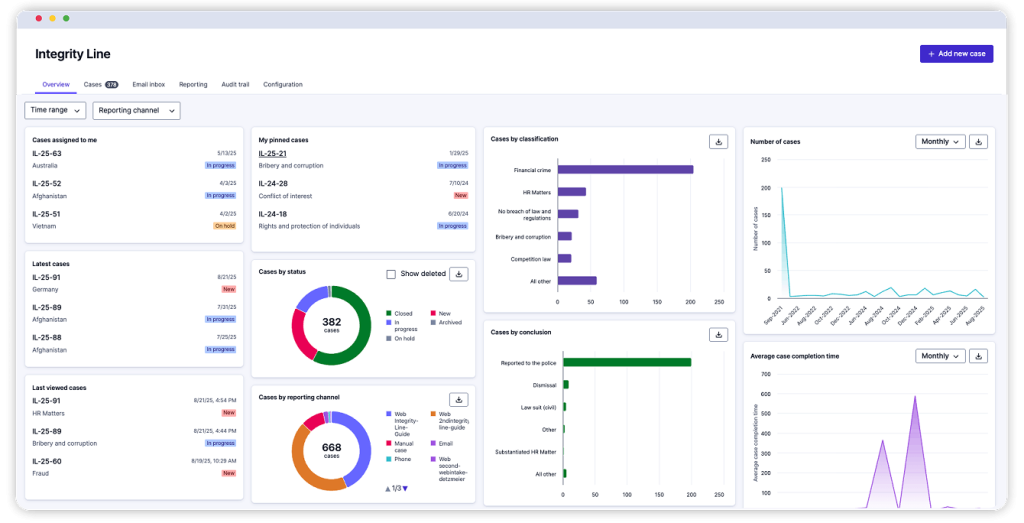
EQS Insights aggregates data across whistleblowing cases, policy attestations, disclosures, and compliance campaigns without external BI tools, manual exports, or pre-meeting reconciliation. Leadership can see:
- Cross-regional reporting patterns
- Investigation consistency by function
- Emerging thematic risk clusters
- Correlation between policy campaigns and speak-up behavior
- Program maturity trends over time
What changes in practice
When reporting and investigation are architected correctly:

Employees report earlier
Because the process feels genuinely safe, straightforward, and worth the personal risk — enabling earlier detection of potential misconduct.
Initial case assessment becomes consistent and timely
Triage is structured, not dependent on who happens to receive the case on a given day. Severity classification is systematic across functions.
Complex investigations evolve without breaking governance
Scope changes, new stakeholders, and evidence loops are accommodated without creating gaps in documentation or ownership.
Regulatory deadlines are tracked systematically, not manually
Acknowledgement timelines and process milestones are automated — eliminating the category of ‘missed deadline due to manual oversight.
Case information is structured and accessible under scrutiny
Every action, decision, and handoff is systematically preserved within the platform. The program is always ready for ad-hoc regulatory or internal requests — not reactive to them.
The program shifts from reactive case handling to structured oversight
Compliance becomes a governance capability, not an operational necessity. It demonstrates value — and withstands scrutiny — continuously.
Built for enterprise governance environments
Technical Infrastructure
- ISO 27001-certified infrastructure
- GDPR-aligned data handling and retention
- Role-based access control with full segregation of duties
- Multi-language and multi-jurisdiction support
Governance Design
- Regulatory-aware workflows (EU Directive, HinSchG, Sapin II)
- Audit-ready documentation preserved systematically throughout
- Designed in Europe. Built for modern governance environments.
- Continuous development informed by regulatory evolution across jurisdictions
If your investigation process bends under pressure, so will your credibility.
See how Integrity Line and Insights work together as one governance system.
Speak Up: Why Whistleblowing Matters
Discover why fostering a speak-up culture isn’t just a compliance goal — it’s a business imperative. This white paper explores the ethical, legal, and reputational benefits of effective whistleblowing systems.
FREQUENTLY ASKED QUESTIONS
What does the EU Whistleblowing Directive require from software systems?
The EU Whistleblower Directive (2019/1937) requires organisations above defined employee thresholds to establish secure internal reporting channels, ensure confidentiality of the reporter’s identity, acknowledge receipt within seven days, and provide feedback to the reporter within three months. Software systems used to fulfil these obligations must therefore support: technically enforced anonymity or confidentiality, two-way communication with the reporter, automated deadline tracking for acknowledgement and feedback timelines, structured documentation of investigation steps, and role-based access controls to preserve investigative independence. Platforms designed for EU Directive compliance — such as those also meeting HinSchG and Sapin II requirements — embed these obligations into the workflow itself, rather than relying on manual process compliance.
What is the difference between a whistleblowing reporting channel and a case management system?
A whistleblowing reporting channel is the intake mechanism — the interface through which a reporter submits a concern, either anonymously or identified. A case management system governs everything that happens after submission: assignment, triage, investigation workflow, stakeholder coordination, deadline tracking, evidence management, and final documentation. Most regulatory failures occur not in the reporting channel, but in the case management layer — where investigations stall, documentation becomes fragmented, and the audit record develops gaps. Integrated platforms address both components as a single governance system, ensuring that the chain of custody from intake to closure is unbroken and auditable.
How does whistleblowing software support HinSchG compliance in Germany?
The German Whistleblower Protection Act (Hinweisgeberschutzgesetz / HinSchG), which transposed the EU Directive into German law, requires organisations with 50 or more employees to establish internal reporting channels, protect reporter confidentiality, appoint an independent case handler, document investigations, and adhere to prescribed acknowledgement and response timelines. Compliant software must enforce these requirements operationally — through zero-tracking anonymity architecture, automated deadline management, role-based access to enforce independence, and systematically preserved documentation. Platforms built to support HinSchG integrate these requirements as structural properties, not as add-on configurations.
What makes an investigation ‘audit-ready’ under GDPR and ISO 27001 standards?
An audit-ready investigation record is one that can be produced, on demand, in a form that is complete, internally consistent, and demonstrably unaltered. Under GDPR, investigation records must also demonstrate lawful processing of personal data, appropriate access controls, and proportionate data retention. ISO 27001-certified infrastructure provides the security framework within which this data is stored and accessed. Audit-readiness is not achieved by generating documentation when scrutiny arrives — it requires that all actions, decisions, stakeholder assignments, and escalations are systematically preserved throughout the case lifecycle, within an environment that is continuously secure and access-controlled.
How should compliance teams present whistleblowing program data to the Board?
Board-level compliance reporting is most effective when it moves beyond case counts to demonstrate program intelligence: whether the reporting channel is generating early-stage signals or only material incidents, whether investigation handling is consistent across functions and geographies, and whether thematic risk patterns are emerging that warrant pre-emptive action. This requires aggregated insight across the case portfolio — cross-regional reporting patterns, investigation consistency metrics by function, correlation between policy campaigns and speak-up behavior, and program maturity trends over time. Platforms that provide this natively, without manual data consolidation, enable compliance leaders to present strategic risk intelligence rather than operational activity data.
What does ‘non-linear investigation workflow’ mean, and why does it matter for regulatory compliance?
A non-linear investigation workflow is one that can accommodate the actual dynamics of real investigations: scope changes mid-process, new evidence requiring re-assessment of earlier findings, additional witnesses or subjects identified after initial triage, or conflicts of interest requiring stakeholder reassignment. Linear case management tools — those that assume investigations proceed through fixed sequential stages — fail to support this reality, leading teams to create informal workarounds outside the system. These workarounds create gaps in the official case record that are visible to regulators and auditors. Non-linear workflow capability allows the platform to mirror investigation reality without compromising the completeness or integrity of the audit record.
Meet our experts
 |
Matthias Zastrow VP, Sales and Compliance Solutions Specialist Matthias brings direct, cross-jurisdictional implementation experience — having guided organisations through whistleblowing program design across HinSchG, Sapin II, and EU Directive environments. Conversations with Matthias focus on your operational reality, your regulatory exposure, and what a defensible program architecture looks like in practice. |
with a compliance expert