Please choose your language:

Visit us in:
Barcelona, Copenhagen, Hamburg, Hong Kong, Kochi, London, Madrid, Milan, Munich, New York, Paris, Vienna, Zurich

Show locations
  • EQS Cockpit
  • Whistleblowing
  • Insider Management
  • Policy manager
  • Investor Targeting
  • Disclosure
  • Webcast
  • Career
Request a demo
Ready to find out how EQS can make your workflows 10x more efficient? Schedule a zero-pressure demo to see how we can support your organization operationalize sustainability management.
  • Meet with an expert who will listen to your specific business needs
  • See our solutions in action, customized for you

AI governance platform: from risk classification to audit-ready documentation

EQS delivers the end-to-end AI governance and a compliance platform built for global enterprises. Move from fragmented policies to centralized, auditable control across your entire AI landscape.

User interface of Integrity Line showing the main dashboard overview with information about the latest cases

Operational excellence for your
AI governance

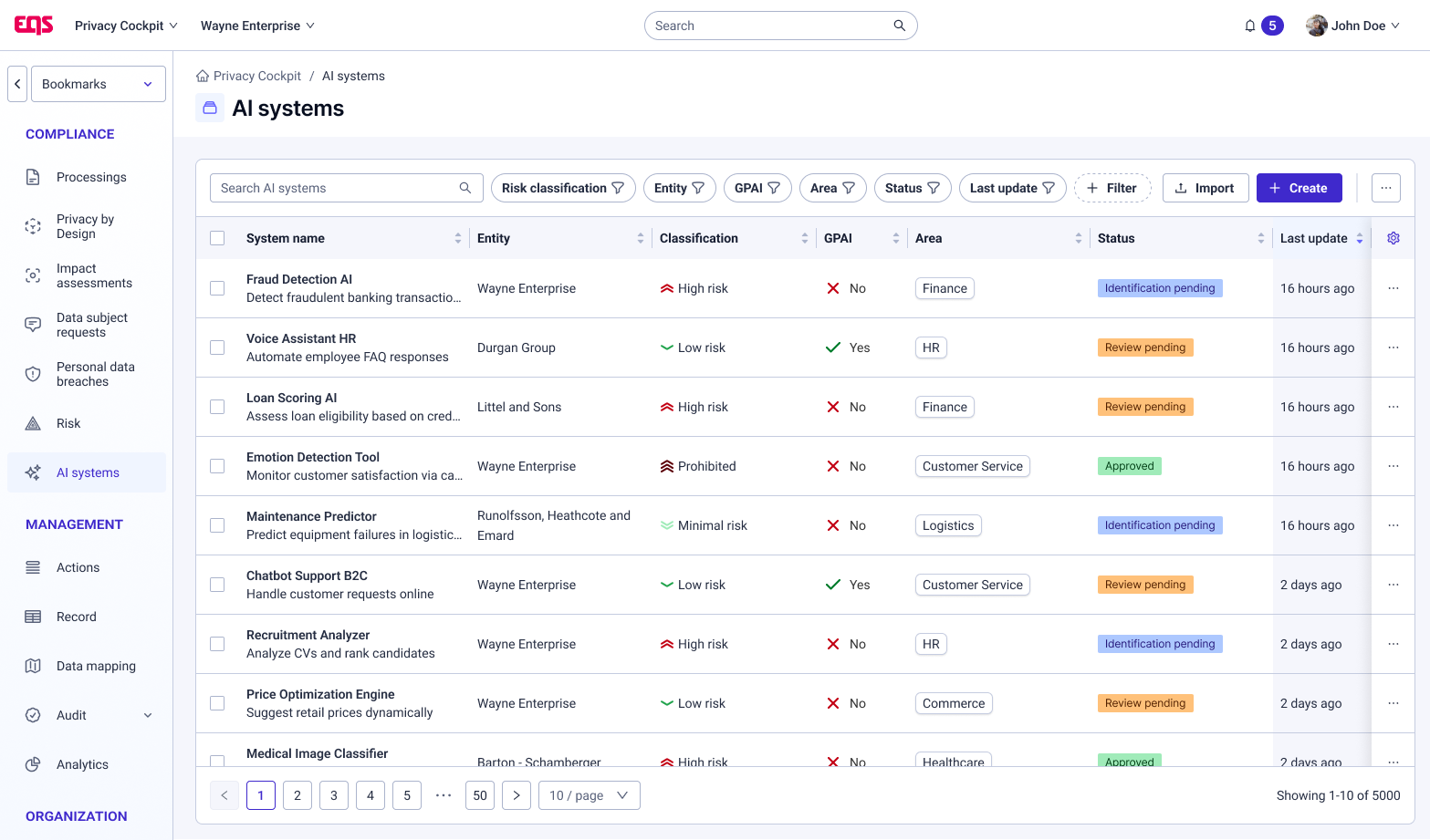
Manage a complete, structured inventory of your AI systems in one place

Reduce AI related risks with integrated risk management

Stay audit-ready with AI Act documentation and continuously monitoring

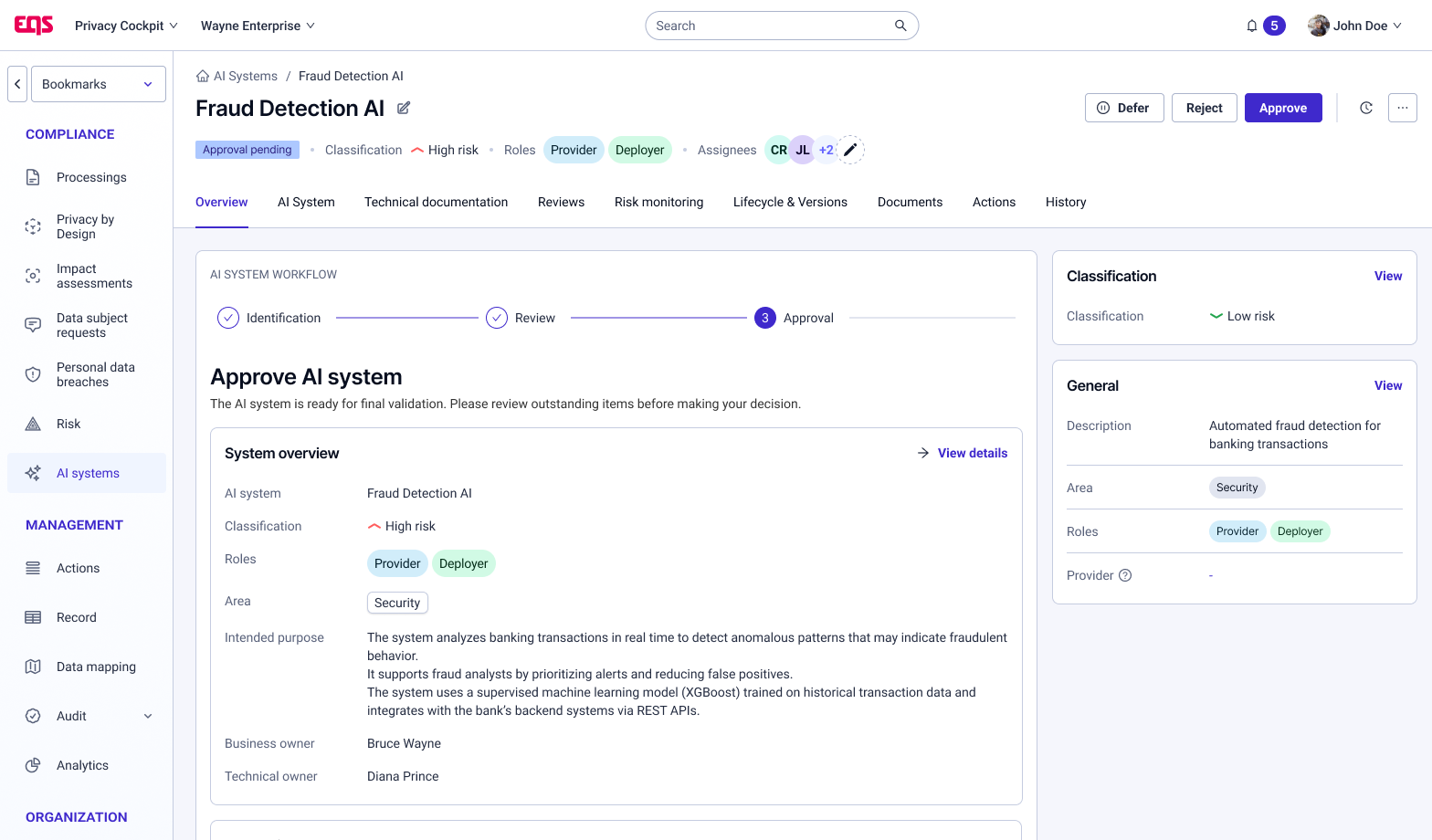
Guide stakeholders through structured review and approval workflows

Trusted by 14,000+ organizations globally for compliance and governance

AI risk at enterprise scale – Invest in AI trust

Digital transformation has made data protection a strategic task, shifting the DPO’s mandate to managing new technologies, AI risks, and complex processes – often without corresponding resource increases. Mature organizations face a governance challenge that cannot be solved with manual, fragmented methods like spreadsheets or static consulting reports.

Distributed AI adoption & fragmented control

Many organizations are deploying hundreds of AI systems across risk, operations, marketing, and product teams. This includes multi-entity operations where no single person has clear visibility into what AI is deployed, who owns it, or what data feeds it across different subsidiaries and business units.

Navigating the EU AI Act’s risk-based tiers

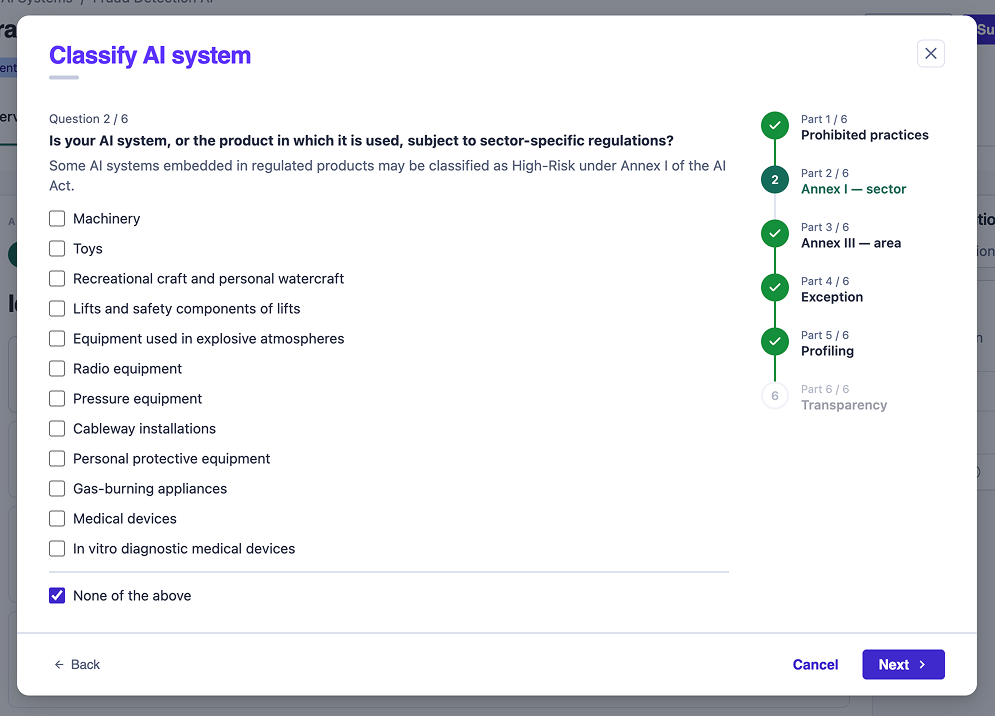
A core operational challenge lies in accurately determining which applications qualify as AI systems under the EU AI Regulation and then assigning them to the appropriate risk category (High-Risk, Limited-Risk, etc.).

Audit exposure from manual processes

Many current compliance programs rely on periodic surveys, static risk registers, and decentralized documentation. This manual approach creates obvious documentation gaps and significant exposure when regulators arrive.

Alignment of multiple regulatory frameworks

AI usage requires the alignment of the EU AI Act with overlapping requirements from GDPR, ESG requirements, product safety regulations, and data protection laws. Managing this overlap leads to redundant and inefficient compliance efforts.

EQS Privacy Cockpit:

The AI governance platform for trustworthy AI, seamlessly integrated in your processes.

The AI governance software Privacy Cockpit empowers DPOs to move from reactive risk management to proactive, demonstrable AI accountability.

Build a centralized foundation for AI governance

Create a single source of truth for AI governance. Maintain a structured inventory of AI systems, models, vendors, versions, business owners, use cases, and related artifacts while collecting the technical and compliance documentation required under the EU AI Act.

AI systems register: Track all AI systems in one centralized inventory, categorized by use case, owner, and risk classification.

AI model repository: Store AI models, versions, vendors, and supporting artifacts in one place to improve oversight and lifecycle traceability.

Technical documentation: Collect and maintain technical, organizational, and compliance documentation required to demonstrate conformity with AI Act requirements and support internal or external audits.

Assess AI use cases and map risks to controls

Evaluate AI use cases consistently with structured assessments and risk mapping. Identify your organization’s role, classify systems by risk, connect them to enterprise risk frameworks, and monitor mitigation activities over time.

AI mapping and classification assessment: Use pre-configured best-practice questionnaires to identify AI systems, assess your company’s role, classify risk, and evaluate AI-related risks.

Risk mapping: Link AI systems to enterprise risk frameworks, assign controls, and monitor mitigation activities across the AI lifecycle.

Guide AI validation from review to approval

Make AI governance actionable with a guided workflow that helps stakeholders move each AI use case through review, validation, approval, and deployment readiness. Assign responsibilities, document decisions, track progress, and ensure every AI system is assessed before it goes live.

  • Validation workflow: Guide stakeholders through a structured review and approval process, ensuring every AI use case is assessed, documented, and approved before deployment. Built-in workflow steps help teams coordinate responsibilities, involve the right stakeholders, capture validation outcomes, and maintain a clear record of approvals and decisions.

3 competitive advantages through AI governance

Organizations that treat AI governance as operational infrastructure will move faster and with greater confidence than competitors still relying on consulting engagements and manual processes. Regulatory deadlines are fixed. Your preparation timeline is not. EQS provides the platform to make AI governance a repeatable, scalable capability.

Executive-level visibility

Board members and regulators get the same real-time view of your AI risk landscape, building confidence across stakeholders.

Operational risk

Centralized monitoring catches drift, bias, and performance degradation before they become regulatory incidents or reputational crises.

Faster innovation cycles

Clear governance processes remove compliance bottlenecks, allowing teams to deploy AI tools with documented risk controls already in place.

01 Built for DPOs AND non-experts

02 One platform for AI Trust and Data Privacy

03 Fast results and outstanding support

04 Secure and compliant by design

05 Scalable for multi-entity organizations

Built for DPOs AND non-experts

Preconfigured templates, automated workflows, and multilingual expert support make it easy to run privacy & AI governance operations without IT knowledge. The user-friendly interface and in-app help ensure an effective cooperation with operational teams.

One platform for AI trust and data privacy

Eliminate redundant compliance efforts by managing both AI trust and data privacy within a single, fully connected platform: AI inventory, risk assessment and documentation for EU AI Act compliance and RoPA, DPIA, DSR, and breach management for GDPR, CCPA, and others are fully connected and automated for consistent, audit-ready documentation and compliance with Privacy by Design principles.

Fast results and outstanding support

Go live in days, not months. Our dedicated team supports you personally – bringing experience from some of Europe’s largest data protection migrations.

Secure and compliant by design

EU-based hosting, ISO 27001-certified infrastructure, and strict access controls ensure maximum security and GDPR conformity.

Scalable for multi-entity organizations 

Central standards with local flexibility, cross-entity reporting, and controlled granular access for subsidiaries and business units.

Need to comply with GDPR and other privacy regulations beside AI Act?

Explore our dedicated GDPR compliance solution.

“The EQS Privacy Cockpit meets our requirements for a central yet decentralized compliance tool. Its user-friendly interface and multilingual support make it easy to roll out across all our business units.”

Danièle Lefur

Group DPO at Econocom

Highest security standards

The EQS Privacy Cockpit operates on ISO 27001 certified infrastructure, offering EU high-availability servers and guaranteed GDPR-compliant data management.

DSQ Certificate logo
ISAE 3000 Type One and Two Certificate logo

Start your AI Act journey today!

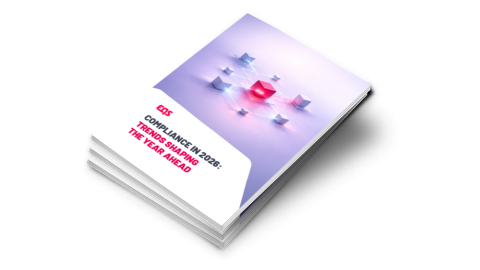
Get our expert-designed, step-by-step mini guide with checklist to preparing and conducting the new EU AI Act!

AI Act

AI Act readiness: key requirements addressed at a glance

For key AI Act requirements: what the EQS AI Act Record addresses – and the added value the shared platform brings for data protection and AI governance.

AI ACT REQUIREMENT
EQS AI ACT RECORD
PLATFORM BENEFIT
AI Act requirement

Record of AI systems

Art. 49 EU registration

EQS AI Act Record

Central AI system record with relevant metadata and exportable documentation

Platform benefit

Links AI systems with your GDPR record of processing activities (ROPA)

AI Act requirement

Risk classification

Art. 6

EQS AI Act Record

Guided classification (prohibited / high-risk / limited / minimal) with automatically assigned obligations per role

Platform benefit

Shared governance and assessment logic with existing data protection and risk processes

AI Act requirement

Technical docs

Art. 11

EQS AI Act Record

Structured technical docs on design, training data, accuracy, robustness, and logging

Platform benefit

Document management, version control, and approval workflows

AI Act requirement

Risk management

Art. 9

EQS AI Act Record

Structured capture, tracking, and treatment of AI-related risks and measures

Platform benefit

Links AI risks with existing risk and assessment processes in data protection and risk management

AI Act requirement

Conformity assessment

Art. 43

EQS AI Act Record

Guided grid for high-risk assessment, exportable as a reliable basis for regulatory audits

Platform benefit

Uses existing assessment and workflow logic from your Compliance processes

AI Act requirement

Ongoing monitoring

Articles 26 & 72: Operators and providers

EQS AI Act Record

Approval automatically sets the next review date, no manual tracking of audit and review cycles

Platform benefit

Task scheduling and reminders via the same workflow base as in data protection

What DPOs should know about EU AI Act

What is EU AI Act?

The EU AI Act is the European Union's landmark, risk-based regulation on Artificial Intelligence. It establishes a unified legal framework for AI across the EU, with the primary goal of making AI systems safe, transparent, non-discriminatory, and respectful of fundamental rights. The obligations imposed vary based on the system's risk category (unacceptable, high, limited, or minimal).

Who does the EU AI Act apply to?

The EU AI Act applies to organizations of all sizes that develop, deploy, distribute, or import AI applications. It also affects organizations based outside the EU if their AI systems – or the outputs generated by those systems – are used within the European Union. 

What are the four risk categories of AI Act?

The obligations set out in the EU AI Act are risk-based, depending on both the role and the type of AI system involved. The EU distinguishes between four categories of AI risk:  

  • Unacceptable risk 

The use of AI systems that conflict with the fundamental values of the EU is strictly prohibited. This includes, for example, AI systems used for social scoring, biometric identification in public spaces, or the covert manipulation of individuals. 

  • High risk 

High-risk AI systems can have a significant impact on health, safety, or fundamental rights and are therefore subject to strict regulatory requirements. These include risk assessment and mitigation, transparency, documentation, human supervision, and data quality. Typical use cases include recruitment, lending decisions, and healthcare applications. 

  • Limited risk 

AI systems with general-purpose or limited-risk profiles are primarily subject to transparency and labelling obligations. Users must be clearly informed when they are interacting with AI, for example, when communicating with a chatbot rather than a human. 

  • Minimal or no risk 

For the majority of AI systems, the EU AI Act does not impose specific obligations, as these systems pose little or no risk to individuals or society. 

What are the penalties for non-compliance with the EU AI Act?

Penalties are severe and intended to ensure compliance, particularly for high-risk AI. Fines for the most serious violations, such as using prohibited AI practices, can reach up to €35 million or 7% of a company’s global annual turnover, whichever is higher. Fines for incorrect information can be up to €7.5 million or 1.5% of global annual turnover.

What is AI governance software? 

AI governance software is a specialized platform designed to operationalize the policies, procedures, and guardrails necessary for the responsible, ethical, and legal use of AI systems. It provides a centralized structure for identifying AI, managing risk, tracking model documentation, and maintaining an auditable trail of compliance throughout the AI lifecycle.

How can AI governance software like Privacy Cockpit support with complying with EU AI Act?

AI governance software transforms compliance from a fragmented, manual effort into a scalable, auditable process by:

  • Automating risk classification: Automatically categorizing AI systems as high-risk, limited-risk, or minimal-risk based on the Act's criteria.
  • Centralizing documentation: Creating and maintaining the required technical documentation.
  • Ensuring audit-readiness: Providing a continuous, verifiable record of compliance, model changes, and risk mitigation efforts for immediate regulatory audits.
Is this AI governance solution suitable for multinational or multi-entity organizations? 

Yes. The EQS Privacy Cockpit supports multi-entity structures with inheritance rules, localized templates, standardized data fields, cross-entity reporting, and configurable access rights. This ensures consistent AI governance and GDPR compliance across all subsidiaries and regions while allowing local autonomy. 

Does the software support frameworks beyond AI Act, such as the GDPR or CCPA? 

Yes. The platform is designed to support multiple international privacy frameworks, including the GDPR, AI Act, CCPA, LGPD, PDPA, and others. Preconfigured templates and workflows help teams manage global compliance requirements within a single system.

Is the EQS Privacy Cockpit secure and GDPR-compliant? 

Absolutely. The platform runs on ISO 27001–certified infrastructure, uses EU high-availability servers, and includes strict access controls, data encryption, logging, and audit trails. All data is processed and stored in full compliance with GDPR requirements. 

Who is EQS AI governance software designed for? 

Primarily for data protection officers, compliance officers, legal teams, IT security teams, and privacy specialists. But not only, our user-friendly and intuitive software is also built for non-experts across the organization to foster easy collaboration and contribute to privacy tasks, helping privacy teams to comply with all regulations. 

Is this software collaborative? 

Yes, absolutely. The EQS Privacy Cockpit is designed as a central collaboration hub, integrating all relevant stakeholders—internal teams and external parties—into your privacy workflows. This approach transforms data privacy from a siloed task into an efficient, organization-wide process.

Is there a support team? 

Yes. We provide fast, expert, and human support to ensure your team is never stuck. You connect with real experts who will respond within minutes, no bots or ticket loops. Our team answers your questions on the spot, in your language, directly within the platform. To help you get started quickly, onboarding sessions are organized every week for all new users, ensuring you utilize the software's full potential from day one. You also have access to a rich knowledge base (manuals and instructions) and in-app help (contextual info boxes and how-to videos) to quickly find answers to common questions. 
Profile Picture of Dikran

Dikran Tabbakh

Account Director Privacy

Dikran heads up the Data Privacy division at EQS Group. He previously spent four years at Data Legal Drive – a company acquired by EQS Group in 2024 – where he supported DPOs and compliance officers in digitizing their GDPR approach.
Profile picture of Matthias Zastrow

Matthias Zastrow

VP, Sales and Compliance Solutions Specialist

Discuss your GDPR privacy software requirements with someone experienced in implementing compliance programs across multiple jurisdictions. Practical guidance from compliance professionals, not generic sales presentations.
Schedule your consultation
with a privacy expert